Nancy Spero Feminist Art Book Nancy Spero Article Download
In 1971, subsequently having completed a series of works on newspaper that used the words of French dramaturg and playwright Antonin Artaud as their subject, American feminist artist Nancy Spero began piece of work on her thirty-seven-panel slice,Codex Artaud. Moving abroad from the relatively small-scale dimensions of her earlierArtaud Paintings (1969–70), Spero began pasting sheets of Japanese Sekishu paper together to course long, thin collages that she described as 'scroll works'.[1] Codex Artaud (1971–2) established the wrought artful and abstruse world that dominates her scrolls throughout the 1970s. Affixed are small, fatigued images of distorted bodies, disembodied heads, and extracts of Artaud's tortured prose, cut out and collaged on. The extended paper back up is largely white and crumpled, punctuated with sheets of coloured and tracing paper that contain typewritten extracts of Artaud'due south texts. As this chapter will expound, this foreign and anxious scroll stands equally an early on representation of Spero'south emerging feminism; developed equally part of her increased involvement in feminist fine art earth activism and an attending to the political potentials of artworks. Thinking about why the coil and its historical resonances seemed politically strong to the artist in the 1970s, I will examine how, for Spero, the scroll format was essential in creating a feminist mode of viewing, becoming in this work, an activist and anti-patriarchal form.[two]
The period during which the whorl emerged in Spero's oeuvre was one where the creative person— every bit 1 of the early members of the feminist art movement—was dedicating herself to activism. Interrogating the weather condition of women's feel under patriarchy, the women's movement in the arts developed existing artful strategies in order to mountain a critique of a organisation that oppressed women as function of its functioning. The focus of these works ranged from an examination of the mechanics of oppression, such as in Mierle Laderman Ukeles' Maintenance Art in which she proposed to exhibit maintenance activities associated with work in the home as her artistic practise, to an attention on the constructed nature of gender, for example every bit demonstrated in Eleanor Antin'sRepresentational Painting(1971), a flick that shows Antin layering her face up with make-upwards over the course of its almost forty minutes. Similarly to these and other practitioners, feminist activism accompanied artful response for Spero. Involved in the institution of feminist groups emerging from the anti-war and artists' rights activism of the Art Workers Coalition—Women Artists in Revolution in New York in 1969, joining the Ad Hoc Women Artists' Commission in 1970, and co-founding the A.I.R. Gallery in 1972—Spero worked with others to actively claiming the blind spots of the art world, to fight for equal representation of women in the arts and to arouse for the end to the maintenance of misogyny through culture.[3]
In her practice, she investigated new textile forms that would stand equally alternatives to what she saw every bit the patriarchal art object, summing up this move with the pithy phrase: 'There, you guys can splat on your big canvases, but I'm over here doing this fragile thing – with bite'.[4]
She had showtime changed her aesthetic approach to adjust political making equally part of her interest in activism against the Vietnam State of war in the mid-1960s. Abandoning the technique that dominated her paintings of the 1950s and early 1960s, such equallyLovers (1962), in which thick layers of oil on canvas were congenital up over months, she created works on paper with brightly coloured gouache and ink, conceiving them as 'manifestos' confronting US governmental aggression in herWar Series (1966-70). Nearing 150 works in total, theWar Seriesrepresented outrage through its sexual, scatological, and aggressive iconography, enhanced past the speed of their making, which left an indexical tape of quick brushstrokes and violent rubbing on the paper's surface. Spero'southward turn to the curlicue in the early 1970s stemmed from her recent ideological date with feminism, standing equally a mode of making that could encourage feminist viewing, rejecting the machismo and bombast epitomised for the creative person in the so ageing abstract expressionist canvas, and instead create an active, reciprocal engagement between viewer and artwork.
TheCodex Artaudis interesting for the ways in which the emerging scroll class manifests both Spero'due south feminist appetite and the anger of theWar Series. Her later works—a key example of which isNotes in Time on Women(1976–nine)—brand women the protagonist, considering a plurality of female identities and experiences.[5] In theCodex Artaud, the visceral outrage and aggression of theWar Series drives the work, simmering in the iconographic and textual elements and creating a visual rendering of the effects of patriarchy on women. Fragmented bodies, decapitated heads, and extended tongues are pictured aslope phantasmal beasts, insect-like creatures, and ripped, stuttering transcriptions of Artaud's texts. The subject is treated violently, both in representation and in the manipulation of Artaud's writing. Spero had chosen Artaud considering of the farthermost nature of his pronouncements, 'forcing a "collaboration"' on him in order to utilize his vast and complex texts on alienation to stand for her own experience, selecting quotations that contributed to her bulletin.[6] Using a visual and textual language of combative disaffection, Spero builds a moving picture of a turbulent globe that evokes the psychic experience of isolation and exclusion. The disorder that the piece of work images is complemented by the elongated paper panel, the effect of its texture and white infinite acting to amplify its terse political proposition.Codex Artaud was Spero'southward kickoff sustained exploration of the scroll; its feminism was articulated through exploring breach in relation to questions of gender, with Artaud's hysterical vox and a focus on the body creating a circuitous consideration of the feminine.[vii] In the long paper supports of the Codex Artaud, an anguished and fragmented thesis is built that obliquely explores the suffering of women living nether patriarchy. The scroll course facilitates this feminist message, most notably in its complex reference to historical practice, but as well in its utilise of paper as a devalued textile, and the way in which the viewer's experience is influenced by the scale of the work.
From its first advent in her oeuvre, the ringlet stood for Spero every bit a synecdoche of the ancient. Equally other chapters in this publication show, the class itself is not past nature historical, with many examples in contemporary art that await to the processes of modernisation and mechanisation in their rolled supports.[8]For Spero, all the same, the scroll signified a pre-modern mode of artful product. 'History' held a dual significance for the work. Primarily, innuendo to historical practice stood in confrontation with formalism, especially a Greenbergian progressive modernism, and its associated machismo. Speaking to Marjorie Welish in 1994, Spero describes her antipathy towards progress: 'You know I don't believe in progress in fine art. Prehistoric art tin can't be shell! Composure isn't progress'.[nine] Referring to historical forms provided an alternative formal linguistic communication that was at once innovative, introducing new modes of making in club to develop culling political and artistic practices, and as well referred to something with weight and authority: a longstanding, respected, and to some extent mysterious tradition with which her work could connect. Scaffolding this is the implication of a lost matriarchy, an alternative historical tradition that has been aggressively erased. It is the enigmatic quality of an allusion to history that creates the 2d level of significance for theCodex. As Benjamin Buchloh has written, theCodexand its repeated reference to historical forms speaks to 'painting's lost resources in myth' and, past extension, 'myth and its "natural" association with the forces of the unconscious'.[10] The sense of deep historical fourth dimension, created by both an iconography inspired by ancient artefacts and in the formal turn to the coil, develops the turbulence figured in the object past referring obliquely to a psychic space. The use of the scroll form acts as a visual shorthand for both a partially recovered history and a desublimated psychological experience.
Spero's interest in imaging a lost past can be read in relation to contemporaneous feminist interpretations of history, which sought to betrayal how history was written to exclude women and plant a narrative of male exceptionalism.[11] For feminism in the 1970s, the official recording of history through fine art had become associated with patriarchy, creating narratives of male achievements and losses, geniuses and leaders.[12] A number of feminist practitioners acted to correct this bias. Works past artists such as Mary Beth Edelson, Judy Chicago, and Betsy Damon, focused on fictional ancient alternatives, representing lost goddesses and matriarchies recovered through their historical allusions.[13] In Damon'south7000 Yr Old Woman (1977), for example, the artist performed dressed in white with her skin and hair painted to lucifer, her lips black to stylise her appearance. Attached to her were iv hundred numberless of coloured flour, referring to the breasts of the Greek Ephesian Artemis. Performing in the street, Damon slowly walked effectually, cutting off the numberless of flour in society to enact a pseudo-ritual.[14] Whilst this work alluded to mythology and history, it did not refer to any specific historical exercise. Instead, the evocation of the aboriginal suggested a suppressed gild, ane which was intimately continued with the female and fertility. Spero's treatment of history echoes this gesture. The sense of the ancient and its framing in relation to feminist concerns proposes another order to be recovered, one which has been suppressed considering of its connection to female experience. Where Damon enacts a ritual of fertility and celebration, Spero'sCodexmanifests the nightmarish underworld of patriarchy, representing the chaos and disorder that mark her experience of information technology. The sense that something is being uncovered is important to Spero; the dominant modes of post-war brainchild were to her mind, 'a cover-up for what was really going on'.[15] By standing in equally a formal allusion to the historical, the scroll lays the footing for this recovered history.
Spero's iconographic and formal reference to history was based on a dandy interest in ancient cultural production. Inspired past her visits every bit a student in Chicago to the ancient artefacts in the Field Museum's collections, Spero had long been invested in an aesthetic linguistic communication that referred to aboriginal cultures.[sixteen] The range of sources that she drew on was wide, encompassing Etruscan, Egyptian, Babylonian, and medieval European practices. Explicit references are made in titles of works or in texts that accompany them to specific historical objects, such as canopic jars, figures—such as the Egyptian Goddess Nut or the medieval nun Ende—or narratives, such as the story of Helen of Troy or the Mesopotamian Goddess Tiamat. In theCodex Artaud there is a repeated reference to ancient Egyptian culture, particularlyThe Volume of the Expressionless, which served as an inspiration for the work.[17] Nonetheless, in spite of this citation of ancient objects and forms, Spero interpreted rather than imitated works according to her own interests, describing her collaged images in theCodex Artaudequally 'symbols ransacked from diverse cultures'.[18] Ransack is accurate: Spero approximated symbols for their rough implications, suggesting something emerging from underneath the weight of scholarly readings, historical interpretation, and masculinist accounts of the past. Appropriating the visual and formal language of these different sources, Spero deliberately affected an anile-aesthetic for theCodex Artaud in club to invoke history-in-inverted-commas, conjuring an approximate and sometimes inaccurate idea of the ancient signalled through the gyre form.[19] Her scrolls are non copies of objects that have gone before—as she explains, 'when a work is completed I realize some of its sources'—nor are the symbols she uses appropriated for their original meanings.[twenty] Instead, they are taken on the footing of their aesthetic and conceptual associations, re-imagined by the creative person equally part of a feminist attack onhistory.

This approximation of historical modes of making, both iconographic and formal, is illustrated byCodex Artaud 5(fig. ane.1). A scene at the centre of the panel in which three silver-grey figures stand, epitomises the way in which history is conjured past the artist. The clearest allusions to a historical exemplar appear in a large, totemic figure to the left of the group and a smaller, composite character on the right. The big figure stares out at the viewer with arms crossed, cut its body in half. Dominating the panel, it exceeds the boundaries of the support, and different the other characters, confronts the viewer straight. With this totemic pose the effigy evokes Egyptian iconography; the neckband that stretches up either side of its head resembles the pharaonic headdresses similar the Khat or Afnet which, combined with its two-dimensional frontality, recalls the tomb statues held in collection in the Field Museum or the coffins in which the museum's mummies are encased. The composite figure, who is pictured with head and legs in profile and torso in full view, faces off the picture plane to the right, its artillery raised so equally to repeat an Egyptian gesture of adoration. The third and fundamental figure, which likewise stands confront-on with arms crossed, is shown looking down at the worshipper. The introduction of roughly sketched perspective in the depiction of this figure's face, departs from the tentative reference to the specific historical language of ancient Egypt.
Although in that location are clues as to what this scene might represent, its meaning is obscured. We could, for case, read the largest figure as a God, drawing on Egyptian stylistic tradition to consider its scale equally prove for this conclusion. Nonetheless, asserting this narrative requires that we ignore other iconographic clues: the fact that the other characters face away from the larger 1; Artaud'south text, which captions the vignette, describing his choice of darkness and hurting over radiance; and the effect of collage, which emphasises the altitude between elements attached to the resonant paper support. Although the figures advise a narrative that is being imparted, their arrangement and their evocative expressions creating the impression of a story that waits to be deciphered, it is as though the code to read them is lost and the viewer is left to make connections from a sense of significance, trying to interpret the deliberately obscure. The creative person's description of her works every bit 'hieroglyphs', in which 'figures themselves correspond language, just equally in the symbols from aboriginal calligraphy or Egyptian art' is suggestive in this regard.[21] Spero treats symbols equally though they were linguistic, and meaningful in that sense, however the viewer is deliberately left without tools for translation; an implication of meaning and loose association is all we can rely on in club to understand the bulletin.
Throughout the work, Spero appropriates historical forms as approximated signs more for a sense of significant than for their authentic reference to historical practice. Titling the workCodex is a good case of this. Every bit suggested by the critic Lawrence Alloway, the naming of the curl work as a codex—which more correctly describes a bound collection of papers, not a scroll—alludes to historical forms, rather than accurately representing Spero's objects. Certain precedents cited by the creative person for her use of the scroll, such as the Bayeux Tapestry and the Beatus Apocalypse of Gerona, the dimensions and stylised figures of which provide inspiration for Spero'due south aesthetic, further demonstrate an approximation of the qualities of objects.[22] Neither the tapestry nor the Apocalypses are themselves scrolls—just like the anachronistic'Codex' Artaud—but instead they are invoked every bit palpably historical, pointing to aspects of the roll that appeal to Spero'south engagement with it: the unfurling pictorial narrative and heavily illustrated manuscript. Equally her work is permanently unrolled and pinned to the wall, the dynamic of revealing and concealing associated with historical rolls and scrolls that derives from the viewer's tactile manipulation of them is hindered.[23] Not appropriating the living engagement with the scroll, therefore, the panels of theCodexare instead more like found objects, presented on museum walls. Creating works that announced historical, that imply a lost practice to be deciphered, Spero'south interest in adopting the class is more almost the manner in which it suggests itself equally an artefact; something that is kept afar, its employ and significance not entirely recoverable.
Also contributing to Spero'southward opposition to modernist tradition is the use of paper as a material, which asserts the artwork as an ephemeral and fragile artefact. Taking on the artistic and disquisitional claims for what Lucy Lippard terms the 'dematerializ[ed] art object' and developing them through her own focus on women's practice, Spero saw paper as a disposable and devalued fabric, one which rejected the veneration of art works and instead encouraged quick, free, and feminist making.[24] Casting bated the oil and canvas of her early practice, which according to this new understanding of materials associated it with a masculinist history of painting, Spero turned to paper. She explains: 'I started to think: I don't desire my stuff to exist and then permanent, then important'.[25] The sexualised, grotesque, and phantasmal picturings of the horrors of the Vietnam War in the War Series were facilitated by paper'due south fragility and impermanence, representing both the violence of the conflict and the vulnerability of the man body. Spero attacked the back up, washing it with gouache in colours abject and bodily, spitting on her brushes and scrubbing at the paper's surface, and so much at times that it ripped and tore during the construction. In theCodex Artaud, Spero similarly used the delicate nature of her materials to contribute to meaning through its tactile and textural presence. The delicacy and friability of the newspaper supports became an important layer of signification; the rips, tears, and buckles in the ground of the paradigm contribute to the turbulence represented in the images of fragmented figures and the broken-hearted fragments of text.
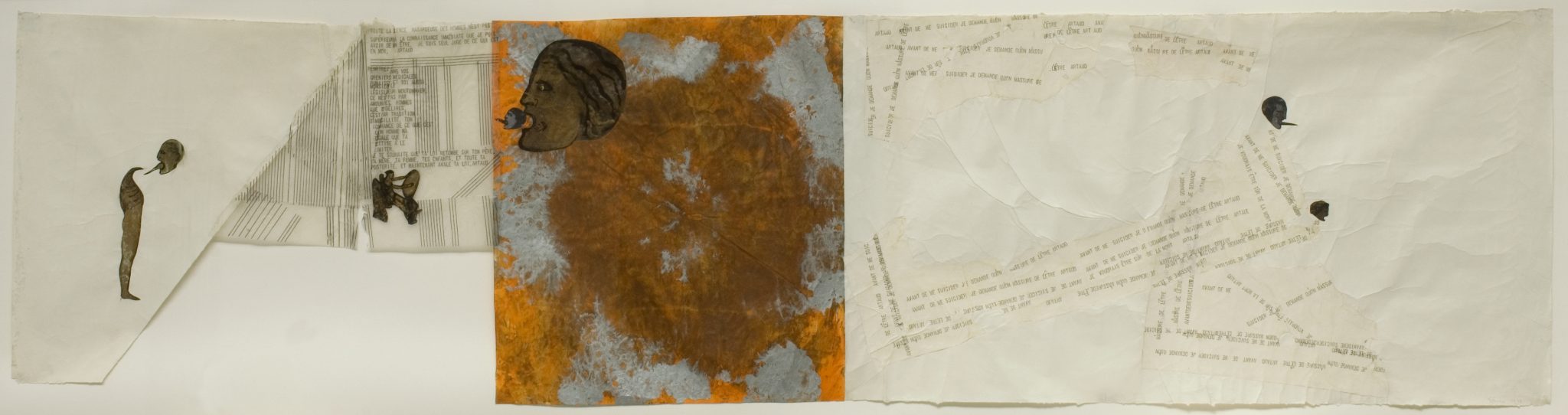
Codex Artaud I stands as an example (fig. 1.2). The materiality of the four paper panels pasted together greatly contributes to its significant. At some points thick, crumpled, and marked, at others so sparse as to be most entirely transparent, the paper creates a resonant and connotative ground. Artaud's appropriated words are typed on separate sheets of newspaper glued to the surface, and so as to pucker the curl and pull the paper into vein-like lines that encounter the support. Multiple transcriptions of Artaud'southward anguished plea—which translates to 'before committing suicide I ask that I exist given some assurance of beingness'—are affixed to a section of newspaper marked with deep creases that grade a web across the film plane, subtly extending the pain of the words into the cloth itself. Creases act every bit echoes of trauma, allegorising the suffering described by Artaud, and creating an unstable footing for this anxious earth. Spero'due south affective pregnant-making is adult in the layered scraps of newspaper containing Artaud's words that are pasted on top of one another. At points, they meld into a unmarried piece that erases and destroys the legibility of the words, echoing the text's anxiety about being and annihilation. Semi-circular rips in these extracts are made more visible through contact with the paper below; their thin, yellowing edges mark them out against the handmade paper of the back up. Spero plays with texture in means that accentuate the delicacy of her medium, emphasising the volatile and precarious world that is congenital of deformed bodies and anguished texts. Fragility here seems to act as a metaphor for psychic turbulence. The disintegration of material elements forms an important function of the piece of work: the edges of the tracing paper that carries a longer section of Artaud'due south text are ripped unevenly; in the centre of the bottom of the fragment a tear runs through the slice, splitting the surface. Farther upwards, the text is obscured by a hard pucker that extends through the centre of this section, pregnant that, although nosotros can discern the words that are typed, they are truncated, partially erased, and interrupted by the frailty of the medium.
The rough edges of the paper panels, where the fibrous quality of the back up are fabricated visible, add to the sense of a disorderly and turbulent world. Equally newspaper, each page consists of multiple individual fibres compressed so every bit to form a whole, creating a chaotic material limerick. Different canvas, in which the material is constructed from ordered lines of cotton or linen, paper is fabricated up of uneven fibres that are shaken to become entwined.[26] Therefore, there is a discontinuity even on a cloth level that allows constitutive elements to be divided across different sheets; not an ordered makeup, but instead an anarchic spread which creates a material that is at one time continued to and separated from itself. The space of the newspaper is one that suggests a space bracketed off, there to be looked at as much as the collaged elements, an equal constituent in the process of making meaning. In their construction from paper, the scrolls assert a concrete and melancholia presence that rejects the 'valuable' artwork, and by extension the system that values it. Newspaper, with its fragility that records trauma to its surface, is an essential contributor to this attack on the masculine fine art object, rejecting the ordered smoothen facade of oil on canvass and instead presenting a traumatised object in which harm is integral to its aesthetic.
A last but important role of this attack past Spero's scrolls on masculine modes of production was an attempt to rethink the relationship between artwork and viewer. Spero sought to cease the wistful function of the spectator, rejecting a mode wherein they would stand and receive the artist's message, instead using the elongated ground of the epitome to forcefulness the viewer to engage with the piece of work every bit an active participant. Although tactile manipulation is refused by their display on the wall, looking at Spero's scrolls, like any scroll, requires a physical relationship with the object; these need that the viewer motility and respond to the contrast betwixt small elements pasted onto the support and the scale of the whole. In inviting an active and actual form of viewing, the creative person played with the dimensions of her fragments in relation to the size of the back up, using pocket-size and delicate extracts of typed texts every bit a means to depict the viewer into an intimate relationship with the work, while large images and an extensive span lead them to seek distance. Moving forth the totality of the piece of work, seeking item in small sections and coherence in the whole, the scrolls engage the body of the viewer, creating meaning through activeness. This relational do creates a unique date for each viewer, allowing for a more reciprocal human relationship—understood by the artist to be feminist—to develop between object and audition.

This style of viewing is visible inCodex ArtaudVandCodex Artaud I: the viewer is required to stand back to take in their span, but must as well come shut to the panel in order to see the particular of their small collaged heads and to read texts that are almost indiscernible from a distance. All the same, the effect is all-time illustrated in Spero's later works, ones in which panels are less autonomous, and instead multiple scrolls are grouped together to explore detail themes. The 1986 workMarduk (fig. 1.3) provides a good example. Describing the ancient Mesopotamian creation myth of Marduk and Tiamat, the three nighttime blue newspaper panels are printed with white ink and have attached to them accounts regarding the contemporaneous oppression of women beyond the world. These accounts are transcribed in English language, including headings from newspaper extracts and man rights reports such as 'REAGAN'S SILENCE ON ABORTION TERROR', 'USSR HOLDS WOMAN IN MENTAL Infirmary', and 'PARAGUAY: 30 YEARS OF Human RIGHTS ABUSE'. By 1986, Spero's focus was on foregrounding women, in this instance their mistreatment under patriarchy, with evidentiary texts affixed to the support, pointing to the continuing violence that women endured beyond the world. These texts are headlined by a transcription of the tale of Marduk'southward violent defeat of the goddess Tiamat in order to take control of the earth and assert lodge over a cluttered realm. It reads:
Marduk defenseless Tiamat in his internet, and drove the winds
which he had with him into her trunk, and whilst her belly
was thus distended he thrust his spear into her, and stabbed
her to the heart and cut through her bowels, and crushed her
skull with his guild. On her torso he took his stand, and with
his knife he split it like a flat fish into two halves, and of one
of these he fabricated a covering for the heavens.
Creating a historical continuity between the violence inscribed in mythology and that described in the texts, this relationship is built by the discrepancies in scale that are central to Spero's active scrolls. In order to read this tale, which spans nine meters across the three panels, the viewer needs to be at a remove to have in the whole business relationship, moving along the paper panels in order to read it in full, then moving back to the far left of the first console halfway through in gild to take in the 2d row of woodblock printed text. That this is to be read in a continuous flow is made clear by the arrangement of lettering: the word heavens, for example, is carve up in two, with the messages 'HE' on the middle console and 'AVENS' on the right. In gild to take in the entirety of the story of the eponymous character, it is necessary not only to be distant from the console, but also to motility forth it. In order to get the detail of the work—the information about the real feel of women—it is necessary to exist close to it and to dedicate time and concentration to a small department. The viewer is brought into a physical and intellectual relationship with the panels; not just do they absorb a message, but they actively create meaning through their approach to the work, developing their own unique appointment through the fashion in which they cull to explore its elements. Tapping into the scroll's mobility as a form, Spero considers this physical relationship—as opposed to the conventional office of the viewer of the artwork—with its expectation of stillness and contemplation. Instead, the experience is described equally cinematic, the way in which a moving picture is congenital involving long-shots and close-ups, vignettes that are loaded with meaning put into context of the whole, edifice an understanding of the piece of work that sees the time spent examining and engaging with the piece equally part of its significance. Describing this in 1972, Spero states:
To viewCodex Artaudane has to change position, to motion
close or further away according to the size of the images … to
motion along every bit in reading a manuscript, or to movement farther away
to view it in its entirety. My ideas on using collage technique are
related to the fleeting gesture, moments (indelible impression)
caught in motion. The rhythm of the whole, seemingly discordant,
incomplete, or inchoate relates to fractured time – as well as the
immediate external realities that impose themselves on my
consciousness.[27]
Challenge a political aspect to this type of spectatorship, seeing its active date as collaborative, not-hierarchical, and feminist, the scroll class enabled a change in the mode in which an artwork claims authority over the viewer. In inviting a response to the object that was based on movement, assuasive the spectator to create pregnant with their journey through the piece of work, the gyre was essential to the evolution of a feminist object. The progress of her do evidences Spero's investment in this way of viewing, which moved from whorl works to interpretations of the heraldic banner inA Cycle in Time(1995), and to large-scale murals that intervened in institutional spaces in ways that exposed their ideological biases. However, her understanding of the scrolls' hope is evident through her consistent engagement with it throughout her career, establishing itself in the early 1970s and culminating in the 2002 workAzur,which was approximately eighty-five meters in length and included a range of images of women from contemporary and ancient sources. Working with the form for over xxx years, the coil was a major part of Spero's aesthetic proposition.
The whorl form, in Spero's feminist reimagining, was appropriated and dispatched as part of a challenge to the aesthetic status quo, seen by the artist every bit complicit in the oppression of women and the perpetuation of patriarchy. With its allusion to history, its devalued support, and its extended scale that demands an unconventional and active mode of viewing, the form was essential to Spero's activist practise. The scroll worked both to signify and to delineate a infinite of signification, its traumatised newspaper supports both the ground for her fragmented images and texts, resonant and meaningful in their own correct. Contributing to the contemporaneous feminist attending to the past that sought to use its linguistic communication equally a way to counter history'southward ideological message, Spero's aroused artefacts mimicked the ancient in lodge to intervene in the gimmicky moment. In this way, for Spero, her interpretation of the scroll course and her manipulation of its resonances were essential to her feminist exercise, a stiff and active way of making.
Rachel Warriner is British Academy Postdoctoral Fellow at the Courtauld Found of Art. Her research focuses on the emergence of activism amid women artists in 1970s New York, because the emergence of feminist fine art in the context of the art politics of the time. This projection builds on her previous work on Nancy Spero which will be published in her volume Pain and Politics in Postwar Feminist Art: Activism in the Work of Nancy Spero, forthcoming from I.B Tauris.
Citations
[ane] Nancy Spero and Stephan Götz, 'About Creation: Interview with Stephan Götz', in Craigen Westward. Bowen and Katherine Oliver (eds), American Artists in Their New York Studios. Conversations Well-nigh the Creation of Contemporary Art (Cambridge, Massachussetts; Stuttgart: Center for Conservation and Technical Studies, Harvard University Fine art Museums; Daco-Verlag Günter Bläse, 1992), p. 149.
[2] It should be noted that Spero is not the only feminist to prefer the scroll equally part of her feminist practice. The most notable other example is Carolee Schneemann's Interior Scroll pulled from her vagina at her performance at the Women Here and Now Festival in East Hampton in 1975 and the Telluride Film Festival in Colorado in 1977, which contained text from her book Cezanne, She was a Peachy Painter. Exploring vulvic infinite, Schneemann used the ringlet to make visible the interior spaces of the trunk, asserting meaning and a challenge to masculine production through her performance.
[3] For more on feminist art and its histories run across Helena Rickett and Peggy Phelan, Art and Feminism (London and New York: Phaidon Press, 2012).
[4] Nancy Spero, Nicole Jolicoeur and Nell Tenhaaf, 'Defying the Death Automobile', Parachute 39 (1985): pp. fifty–55; reprinted in Roel Arkesteijn (ed.), Codex Spero: Nancy Spero — Selected Writings and Interviews 1950–2008 (Amsterdam: Roma Publications, 2008), p. 15.
[5] See Nancy Spero and Jeanne Siegel, 'Nancy Spero: Adult female as Protagonist', Arts Magazine 62 (1987): pp. ten–13.
[6] Nancy Spero and Barbara Flynn, Nancy Spero. 43 Works on Newspaper. Excerpts from the Writings of Antonin Artaud (Cologne: Galerie Rudolf Zwirner, 1986), p.one.
[7] Although Spero asserted that Codex Artaud was not feminist, instead claiming it as a pre-feminist practice in that it did not explicitly foreground women and their experience, it undoubtedly shows an attention to feminism'due south intellectual concerns; the focus on the trunk as the site and signifier of existential pain suggests an involvement in embodiment and a dedicated attention to emotion every bit a serious subject for intellectual enquiry. See Spero and Tamar Garb, 'Nancy Spero interviewed by Tamar Garb', Artscribe International (1987): p. 59. Mignon Nixon describes how the Codex Artaud explores a hysterical subjectivity that develops a consideration of both sexuality and gender. See Nixon, 'Book of Tongues', in Dissidances (Barcelona: Museu d'Fine art Contemporani de Barcelona, 2008), pp. 21–53.
[eight] For example, artists similar Robert Rauschenberg'due south Automobile Tire Print (1953) and Jean Tinguely's Méta-matic n17 (1959) produced indexical prints on rolls of paper, parodying the procedure and results of mass production.
[9] Nancy Spero and Marjorie Welish, 'Word into Image. An Interview with Marjorie Welish', BOMB 47 (1994): pp. 42–44; reprinted in Arkesteijn, Codex Spero, p. 155.
[10] Benjamin Buchloh, 'Spero's Other Traditions' in Catherine de Zegher (ed.), Within the Visible (Cambridge: MIT Press, 1996), p. 243.
[11] Talking to Tamar Garb in 1987, she states: 'I think of history painting equally a monument to a moment or a meeting in which there is usually a male activity', Spero and Garb, 'Interview', p. 62.
[12] Texts such as Linda Nochlin's foundational 'Why Accept There Been No Great Women Artists', published in 1971 opened give-and-take, considering the terms by which this exclusion was perpetuated. For case, the lack of educational opportunities for women, the expectations of established gender roles, and the emphasis on the creative person genius understood to be male person. See Nochlin, 'Why Have There Been No Slap-up Women Artists', ARTnews (1971): p. 22.
[xiii] Mary Beth Edelson'southward 1973 photograph, Woman Ascension for example, involves manipulations applied to the creative person'due south image in society to imply a primordial and spiritual connectedness to the world, alluding to a lost matriarchy connected to nature.
[14] Jayne Wark examines Damon'southward functioning in more than detail in her Radical Gestures: Feminism and Performance Fine art in North America (Montreal: McGill-Queen's Printing, 2006), pp. 63–64.
[15] Nancy Spero and Robert Enright, 'Picturing the Autobiographical War. An Interview with Robert Enright', Border Crossings 23, no. 1 (2004): pp. 50–61; reprinted in Arkesteijn, Codex Spero, p. 35.
[16] Spero articulates the influence of the museum'due south vast collections of ancient artifacts which were, according to the artist, 'literally dumped out of the cases'. Run into Nancy Spero, Kate Horsfield and Lyn Blumenthal, 'On Art and Artists: Nancy Spero', Profile 3:1 (1983): p. 2.
[17] Spero states: 'When I started pasting the paper together for the "Codex" I was looking at Egyptian hieroglyphics – their methods of limerick on walls and papyrus, to give me some ideas, and forth the way I collected many images and references'. Meet Spero quoted in Jon Bird, 'Part 2, "Codex Artaud" – the phallic tongue', in Nancy Spero (London: Plant of Gimmicky Art, 1987), p. 25.
[xviii] 'Argument for Magiciens de la Terre' (1989), Box 5, Folder eleven, Nancy Spero Papers 1940s–2009, Archives of American Fine art, Smithsonian Institution, Washington, D.C.
[19] For case, in her process of making the scrolls, she describes her use of Higgin's vegetable mucilage for the way information technology puckered and yellowed the newspaper, telling Stephan Götz in 1992 that: 'I wanted the piece of work to look old'. Spero and Götz, 'Most Creation', p. 117.
[xx] Spero, 'Narrative Aspects of the Piece of work', in Arkesteijn, Codex Spero, p. 83.
[21] Spero and Welish, 'Word into Paradigm', p. 155.
[22] Spero discusses the influence of the Bayeux Tapestry in her interview with Judith Olch Richards. Run across, Oral history interview with Nancy Spero, (February half dozen–July 24 2008), Archives of American Art, Smithsonian Institution. Spero's involvement in the Beatus Apocalypse of Gerona is almost conspicuously articulated in her text 'Ende', which considers the work of the nun Ende who is credited with illustrating this text. See, 'Ende', Women's Studies 6 (1978): pp. 3–11.
[23] Whilst originally pinned to the walls, Spero's works are now framed behind drinking glass, pointing to their fixed status equally objects that are unrolled and designed for display.
[24] See Lucy Lippard, Six Years: The Dematerialization of the Fine art Object from 1966 to 1972(Berkeley: University of California Press, 1973). For Spero, paper also acted as a metaphor for the denigrated status of women artists' work. She states: 'If women'due south work is considered less valuable monetarily, then work on paper is considered even less'. See Spero, Jolicoeur and Tenhaaf, 'Defying the Death Car', p. fifteen.
[25] Spero, Jolicoeur and Tenhaaf, 'Defying the Death Machine', p. fifteen.
[26] 'Production Procedure', Sekishu Washi, accessed 29 July 2015.
[27] Nancy Spero 'Viewpoint' (Nov 1972), Box 5, Folder ix, Nancy Spero Papers 1940s–2009, Athenaeum of American Art.
Download PDF
'This Delicate Thing – With Bite': Nancy Spero'due south Feminist ScrollsDOI: 10.33999/2019.02
garnergromemence01.blogspot.com
Source: https://courtauld.ac.uk/research/research-resources/publications/courtauld-books-online/continuous-page-scrolls-and-scrolling-from-papyrus-to-hypertext/1-this-fragile-thing-with-bite-nancy-speros-feminist-scrolls-rachel-warriner/
0 Response to "Nancy Spero Feminist Art Book Nancy Spero Article Download"
Post a Comment